Voltaire is, arguably, one of the most famous of all French philosophers, being one of the three philosophes of the French Enlightenment, along with Rousseau and Diderot. He published, and had reasonable success with, many works, and his novella Candide, published in 1759, was the third of four texts studied on Provoking Thoughts. The novella is, from a fictional and literary point of view, an adventure story, telling the story of its eponymous protagonist Candide, in his adventures across the globe. Of course, whilst it is a very entertaining read (I strongly recommend you give it a perusal even if you have no interest whatsoever in philosophy or Enlightenment values - a translation is available for free here on Literature.org, possibly one of my favourite sites ever), it is also a philosophical satire on a whole host of things. The principal of which, in my opinion, is the philosophy of Optimisme.
Let me first introduce you to Gottfried Leibniz:
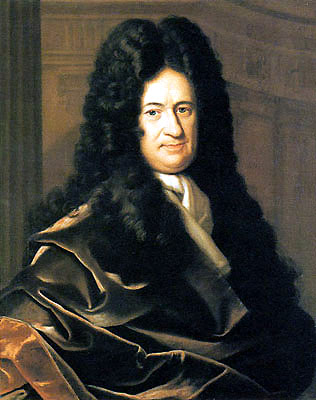
Anyway. This guy was a German philosopher in the 17th and early 18th Century, who raised a few principles in his life, one of which was the Principle of Sufficient Reason, which states that:
Since there is an infinity of possible universes in God's ideas, and since only one of them can exist, there must be sufficient reason for God's choice.This principle in turn led to the idea that, if God has "sufficient reason" for creating this world, then it must mean that everything in this world is right, and for the best. Let me now introduce you to Alexander Pope:
 |
| What's over there, Al? |
All nature is but art, unknown to theeVoltaire directly opposes this idea in his Poème sur le désastre de Lisbonne (for more info about the Lisbon Earthquake of 1755 click here, or, indeed, read Candide!), writing the following:
All chance, direction, which thou canst not see
All discord, harmony not understood
All partial evil, universal good
And, spite of pride, in erring reason's spite,
One truth is clear, whatever is, is right.
O malheureux mortels! O terre déplorable!Now, if there is one phrase you may get bored of when reading Candide, it's "tout est bien". It's everywhere. Said by, most of all, the magnificent philosopher that is Pangloss. No matter what happens in the novella, no matter how much pain, suffering, and horror he witnesses, Pangloss maintains the view not just that "tout est bien", but that "tout est au mieux". He states that "...tout étant fait pour une fin, [donc] tout est nécessairement pour la meilleure fin". This would be fine, if it weren't for his justification:
O de tous les mortels assemblages effroyable!
D'inutiles douleurs éternel entretien!
Philosophes trompez qui criez 'Tout est bien'
Accourez, contemplez ces ruines affreuses,
Ces débris, ces lambeaux, ces cendres malheureuses.
Remarquez bien que les nez ont été faits pour porter des lunettes, aussi avons-nous des lunettes. Les jambes sont visiblement instituées pour êtres chausées, et nous avons des chausses [...] ceux qui ont avancé que tout est bien ont dit une sottise; il fallait que tout est au mieux.Voltaire clearly isn't wanting us to agree with this guy. But it gets even better. Having contracted syphilis from a serving-girl, Pangloss reasons with the lamenting Candide with these words:
C'était une chose indispensable dans le meilleur des mondes [...] car si Colomb n'avait pas attrapé dans une île de l'Amérique cette maladie qui empoissone la source de la génération, [...] nous n'aurions ni le chocolat ni la cohenille.That's right. "Oh it's fine that I have syphilis, because without syphilis, we wouldn't have chocolate or red dye". Now that's logic for you. And this (arguably absurd and flawed) logic continues throughout the novella. He prevents Candide from saving his saviour and friend Jacques the Anabaptist because "la rade de Lisbonne avait été formée exprès pour que cet anabaptiste s'y noyàt". He attempts to console the survivors of the Lisbon earthquake by telling them that "s'il y a un volcan à Lisbonne, il ne pouvait être ailleurs. Car il est impossible que les choses ne soient où elles sont. Car tout est bien." Shortly after this declaration, Pangloss is supposedly hanged, and so Candide is free to start forming his own ideas about the world. He no longer has Pangloss to explain away all the bad things in the world, and so starts to question the validity of Pangloss's philosophy. After finding his beloved Cunegonde in Lisbon, and finding out her story, he says "Pangloss m'a [...] bien cruellement trompée quand il me disait que tout va le mieux du monde". Candide continues to witness many horrors throughout his journey, and each time he questions more and more how Pangloss can maintain that this is the best of all worlds, eventually leading to his rejection of the philosophy in Surinam:
"Qu'est-ce qu'optimisme? disait Cacambo. - Hélas! dit Candide, c'est la rage de soutenir que tout est bien quand on est mal"This does not last forever, however, as the thought of being reunited once and for all with Cunegonde at Constantinople causes Candide to proclaim that "Pangloss avait raison: tout est bien". As it turns out, Candide is not only reunited with his (now ugly, not that it should matter *ahem*) Cunegonde, he is also reunited with Pangloss, who, of course, still maintains his philosophy, even going as far as, at the very end of the novel, to suggest that all of the events in the novella, all of the war, terror, catastrophe and horror, were all for the best, because without all of the events leading up to the conclusion of the plot, they would not have their garden:
'Tout les événements sont enchaînés dans le meilleur des mondes possibles; car enfin, si vous n'aviez pas été chassé d'un beau château à grands coups de pied dans le derrière pour l'amour de Mlle Cunégonde, si vous n'aviez pas été mis à l'Inquisition, si vous n'aviez pas couru l'Amérique à pied, si vous n'aviez pas donné un bon coup d'épée au baron, si vous n'aviez pas perdu tous vos moutons du bon pays d'Eldorado, vous ne mangeriez pas ici des cédrats confits et des pistaches.'If that's not satire, I don't know what is. In a time when the world was shaken not just by natural disaster, but by countless wars, civil unrest, invasion and more besides, the idea that "everything is right" is simply ludicrous. Of course, there's nothing wrong with being optimistic. But to suggest that we live in the best of all possible worlds is, well, mildly insane, if you ask me. And Voltaire clearly thought so too :-P
(Sorry for the length of the post...)

No comments:
Post a Comment